
Ecommerce Consulting: What an Ecommerce Consultant Does and How They Help Your Shop Sell More
You've invested in an ecommerce website, you've listed your products, you've even spent some money on advertising. But sales aren't taking off the way you expected.
Or you're just starting out and want to avoid the most common mistakes: the wrong platform, no analytics, an unoptimized checkout. In both cases, an ecommerce consultant is a strategic lever, not an expense.
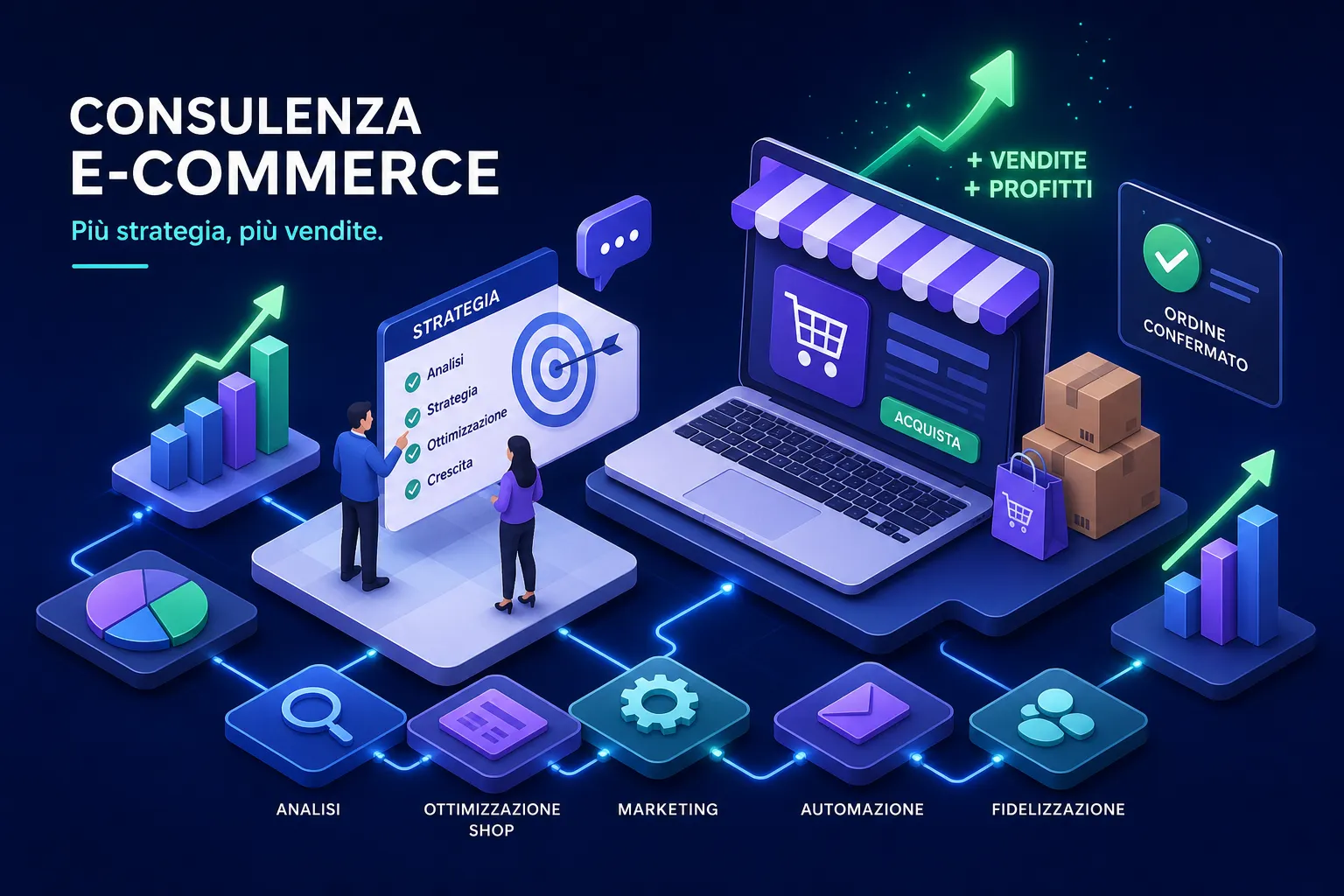
An ecommerce consultant isn't an expense: it's a strategic lever. Provided you know how to choose one, what to ask, and which numbers to evaluate them on. Teams like Zeno Web, a PrestaShop Partner agency active for 14 years, work with the mindset of a partner, not a vendor: the goal is to grow your shop, not simply deliver a service.
On this page you'll find everything you need to make an informed decision: what a modern ecommerce consultant actually does, when to involve them, which services they should cover, how to evaluate them with concrete KPIs, how much it costs and which questions to ask in the first call.
What a modern ecommerce consultant actually does
The ecommerce consultant is not "the one who builds your website". Anyone who still associates the role solely with technical development has an outdated view.
A digital commerce expert operates on several fronts in parallel: they analyze the funnel, interpret data, review advertising campaigns, optimize the checkout and define a measurable growth roadmap. They don't just execute: they translate insights into concrete actions.
For example, they may start from a checkout audit, identify three critical points of friction and turn that data into concrete interventions on UX, communication, payment methods, speed or the purchase process.
This is the substantial difference between someone who "manages" an ecommerce store and someone who makes it grow. The first maintains the status quo. The second questions it, identifies bottlenecks and works to eliminate them with clear priorities and verifiable results.
Strategist, analyst and optimizer: overlapping functions
In everyday practice, an ecommerce consultant works on platform audits, conversion funnel analysis, Google and Meta campaign reviews, checkout optimization and proper tracking setup.
Each activity is connected to the others: there's no point in increasing traffic if the checkout is full of friction, just as there's no point in optimizing the conversion rate without reliable data to rely on.
A good consultant knows how to read numbers and turn them into operational guidance. They don't just deliver a monthly report: they tell you what to change, why and with what priority, producing concrete deliverables like quarterly roadmaps with target KPIs, lists of critical bugs found during technical audits and improvement hypotheses to test.
Freelance ecommerce consultant vs. specialized agency: when each is the right choice
The freelance ecommerce consultant is often more flexible and suitable for specific projects or limited budgets. They offer direct contact, decide autonomously and adapt quickly to change.
The limit lies in the coverage of skills: few freelancers cover SEO, Ads, CRO, analytics and technical integrations with the same depth.
An ecommerce agency with dedicated teams on development, marketing and analytics is the best choice when the project requires continuous operational execution across multiple channels in parallel.
If your shop already has volume and you want to scale in a structured way, the integrated team model reduces risks and accelerates results.
When is the right time to involve an ecommerce consultant
Not every online store needs an ecommerce consultant at the same time. In practice, three situations tend to recur where their involvement becomes almost mandatory. Recognizing which one you're in is the first step to avoid wasting budget.
You're launching your first online shop
Those who start from scratch often make the same mistakes: the wrong platform for the product, a weak SEO structure from the homepage, an unoptimized checkout, analytics configured approximately.
An ecommerce consultant at the launch stage prevents you from having to redo everything six months later. In most cases, the cost of an initial architectural error exceeds that of preventive consulting, especially when it comes to migrating from one platform to another after launch.
Sales have stalled or are declining
If you have traffic but conversions aren't growing, or if revenue has flattened despite advertising investments, the problem is almost always structural.
An expert identifies the bottlenecks in the funnel through a technical and strategic audit, and sets up a prioritized roadmap of interventions.
It's not a matter of working more: it's a matter of working on the right points.
You want to scale or integrate new channels
Expanding to Amazon, eBay or other marketplaces, connecting the platform to a business management system, automating email marketing: these are interventions that require both technical and strategic skills.
An ecommerce consultant with experience in these areas knows how to navigate the most common pitfalls: unexpected commissions, duplicated data between systems, inventory misalignments, catalog synchronization problems, pricing errors or outdated stock.
The services a serious ecommerce consultancy should cover
A good ecommerce consultant doesn't specialize in a single channel. The added value lies in having an overall view: they know how SEO, Ads, CRO and analytics influence each other, and they work on all these fronts in a coordinated way.
Always ask what is included in the consultancy, what the concrete deliverables are and, just as importantly, what is not covered, because partial consultancies often leave uncovered exactly the areas that are holding back growth.
SEO, Ads and CRO: the growth engines
SEO brings qualified organic traffic in the medium-long term. Ads campaigns, such as Google Shopping, Performance Max and Meta Ads, generate more immediate results, but burn through budget quickly if not optimized.
CRO, i.e. conversion rate optimization, improves the return on both investments by reducing the cost per acquisition.
An online shop consultant who works only on one of these areas produces limited results over time. Improving conversions amplifies the effectiveness of SEO and Ads, and vice versa.
That's why, in an effective ecommerce consultancy, conversion optimization shouldn't be treated as a separate activity, but as part of a broader work on traffic, UX, data, checkout, product pages and commercial strategy.
Advanced analytics and tracking: the foundation of every decision
Without reliable data there's no serious consulting. Setting up tracking correctly means configuring the DataLayer, the tag manager, the conversion funnels and custom dashboards.
An ecommerce consultant must know how to turn data into concrete actions, not just deliver monthly reports that are hard to interpret.
The difference between a shop that grows and one that stagnates often plays out exactly here.
Marketplaces and integrations with business systems
For many small and mid-sized companies, the most requested integrations concern widely used ERP systems, CRMs and warehouse management platforms.
On the marketplace front, Amazon and eBay require precise management of product listings, pricing and logistics.
A marketplace consultant with experience in these areas knows how to avoid the most common configuration problems and reduce the risk of unexpected costs.
How to recognize a good ecommerce consultant: certifications, KPIs and questions to ask
To evaluate who's in front of you there are three levels: formal credentials, KPIs to agree on and questions to ask in the first call. Using them together lets you distinguish a serious professional from those who sell promises that are hard to verify.
Certifications and references to verify before signing
Among the most verifiable certifications there's Google Ads, Google Analytics and Google Shopping for the advertising and measurement side, the PrestaShop Partner certification for those working on that platform, and the professional qualifications related to the ecommerce and digital marketing world.
Beyond certifications, what matters are case studies with verifiable numerical data: a serious consultant shows concrete results, not just presentation slides.
Ask for direct references from clients in the same industry or in contexts similar to yours.
The KPIs to agree on from the first call
Five key indicators to measure the effectiveness of the ecommerce consultant over time:
Conversion rate
The percentage of visitors who complete a purchase: it's the most direct KPI to assess the shopping experience.
AOV – Average Order Value
The average value per order: it tells you if you're selling higher-value products or successfully cross-selling.
LTV – Customer Lifetime Value
The total value of a customer over time: it measures the quality of the relationship and retention.
CAC – Customer Acquisition Cost
How much you spend to acquire a new customer: analyzed together with LTV, it tells you if your model is sustainable.
Cart abandonment rate
It flags the frictions in the checkout that are slowing down sales.
For a deep dive on the main performance indicators for ecommerce you can check the dedicated resources on ecommerce KPIs on NetSuite.
These KPIs must be analyzed together, not individually. Without objectives agreed in advance, there's no way to evaluate whether the consultancy is actually working.
10 operational questions to ask in the initial call
These questions help you evaluate the specific skills of the ecommerce consultant you're evaluating, going beyond generic presentations.
- What is your process for developing a tailored ecommerce strategy?
- Do you have specific experience in my industry or in similar contexts?
- How do you measure results and when should I expect the first outcomes?
- How do you analyze my market and competitors before starting?
- Which tools do you use for tracking and how do you verify data reliability?
- Which channels do you prioritize for my specific situation and why?
- Have you worked with ERP or CRM integrations? On which platforms?
- How do you organize reporting and how often?
- Do you work alone or do you have a support team on specific areas?
- How do you plan the assigned budget to maximize ROI?
How much does ecommerce consulting cost in 2026
Addressing the topic of costs without ambiguity is a must.
Hourly rates can vary based on the consultant's experience, project complexity, the platform used and the level of support required.
A freelance ecommerce consultant can have different costs than a structured team, just as a simple strategic consultancy carries a different weight than an ongoing engagement involving SEO, advertising, CRO, analytics, technical development and integrations.
The price should always be evaluated against expected results.
As an example, assuming the same traffic volume and the same average order value, if your ecommerce generates 10,000 euro in monthly revenue with a 1% conversion rate, bringing it to 1.5% already produces an additional 5,000 euro per month.
In this scenario, a consultancy at 1,500 euro per month would pay for itself in a few days.
Of course, the ROI of consulting is always calculated on net margins recovered, not just on the revenue generated and not on the hourly cost.
Zeno Web: ecommerce consulting with a technical, strategic and measurable approach
Zeno Web is a concrete example of how a structured ecommerce partner works differently from a simple service provider.
Based in Catania and with over 14 years of experience in the ecommerce world, the team integrates PrestaShop development, data-driven marketing, SEO, advertising, analytics, automation and technical support into a single working ecosystem.
It's not a pure software house, it's not a classic generalist web agency: it's a partner that combines technical execution and strategic vision at every stage of the project.
In several ecommerce projects we've achieved significant sales growth, even in excess of +180%, thanks to integrated work on strategy, advertising, technical optimization and data analysis.
This result is possible because Zeno Web doesn't limit itself to theoretical consulting: it works on custom analytics, tailored dashboards, performance optimization, campaign monitoring, funnel analysis and continuous improvement of the shopping experience.
The methodology always starts from an analysis of the platform and funnel, produces a prioritized roadmap with measurable goals and translates into concrete interventions monitored over time.
The first free conversation allows us to analyze the general situation of the shop, identify the main critical points and understand which interventions can have the highest priority.
Want to understand what's limiting the growth of your ecommerce?
Book a first consultation with Zeno Web and together we'll analyze platform, data, traffic, conversions and intervention priorities.
Book an ecommerce consultation