
How to choose the right Shopify Partner for your SME
Technical skills, migration handling, data tracking and warning signs: what to really assess before you entrust your store to a Shopify partner.
Published 21 September 2026 — Last reviewed: 21 September 2026
A clothing shop decides to take its catalogue online. It finds a developer on a freelance marketplace, signs a contract, waits three months and receives a store that looks acceptable. Unfortunately, purchase tracking does not work, product pages take six seconds to load on mobile and nobody knows how the redirects from the old platform were set up. In the following weeks organic traffic collapses: Google reads the missing pages as errors, rankings drop and clicks are lost. Choosing the wrong Shopify partner has concrete consequences that are often hard to recover from.
A certified partner of the Shopify programme is not simply a developer who knows the platform. They have access to a dedicated Partner Dashboard, can create free test stores for clients and receive API updates before public release, working inside an ecosystem with its own rules, resources and tools. For an SME the difference is practical: you are dealing with someone who knows the platform's logic from the inside, not someone learning it on your project.
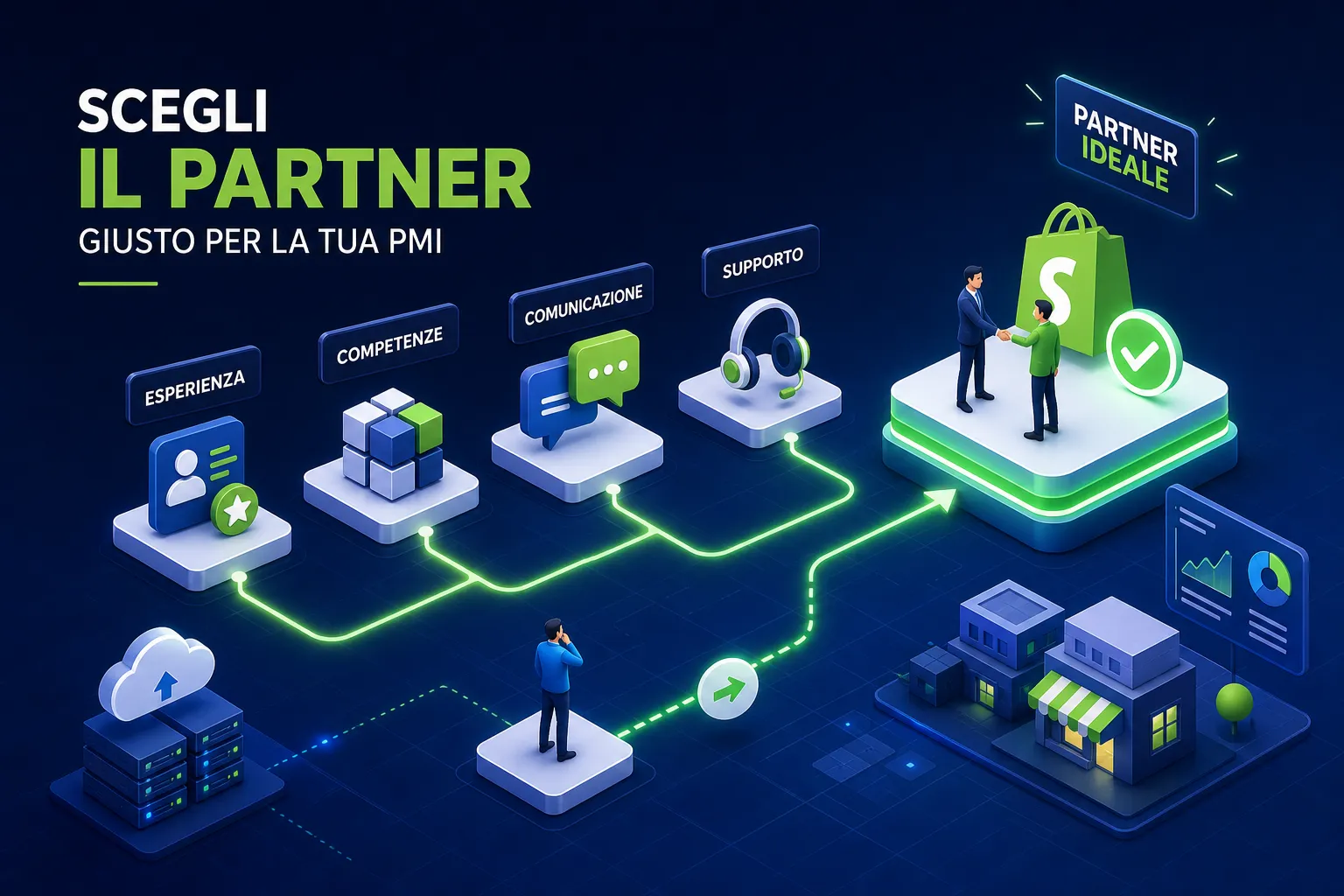
In the sections below you will find the concrete criteria for assessing a Shopify partner before signing any contract: the technical skills that make the difference, the warning signs to spot straight away and an operating checklist to use in briefings. If you are already evaluating a quote, you can compare it with the scope of work described on the Shopify agency page.
What a Shopify partner really does (and how it differs from a generic freelancer)
The official Shopify programme includes several types of partner an SME can work with: the agency, which covers everything from development to marketing; the developer, focused on technical implementation; the Shopify Expert, a qualified professional with visibility in the official marketplace. There are also app partners and theme partners. These profiles are not interchangeable: the choice affects the cost, timing and results of the project.
Anyone migrating from an existing platform, such as PrestaShop or WooCommerce, needs very different skills from someone launching a first store from scratch. In the first case you need URL migration, product variant mapping and preservation of SEO history. In the second the focus shifts to catalogue architecture, tracking and launch strategy. A generic professional rarely covers both areas with the same depth.
Does the partner ask about your business model before proposing solutions, or arrive straight away with a standard quote? A serious professional listens first and proposes later.
Which services to expect from a serious Shopify agency
A migration to Shopify is never a simple transfer of products. Existing URLs, SEO history, customer data and catalogue logic must be preserved. A competent partner first runs a full audit of the starting site: it inventories the indexable pages, maps every URL to its counterpart in the new structure and implements 301 redirects to carry over the authority built up. Without this phase organic traffic can collapse within weeks.
Integrations and payments for the Italian market
On the technical side a Shopify agency must cover store development and customisation, integration with payment systems (Stripe, PayPal, Klarna and, where needed, Nexi) and connection to an ERP or CRM. VAT handling, national couriers, GDPR compliance and the payment methods most used in Italy are things a partner with direct experience of the local market knows by default, not from theoretical documentation. On this topic you can read more about eCommerce integrations.
Tracking and automations: where you win or lose
A serious partner does not just install the platform. It sets up event tracking on GA4, the Meta Conversions API, automations for abandoned carts and post-purchase sequences, and provides reports that go beyond Shopify's basic statistics. Without clean data, any advertising investment is blind. Campaigns optimise on the data they receive: if purchase events arrive duplicated or missing, the budget ends up on the wrong audiences.
How to assess technical skills before you sign
A competent partner speaks the language of data from the first conversation. If metrics such as Largest Contentful Paint, conversion rate by device or cost per acquisition do not come up in the first discussion, treat it as a warning sign. Phrases like “we will increase visibility” with no concrete KPIs are not a strategy: they are a way of not being measured.
The portfolio should be read with a critical eye. What counts is not how many stores they have built, but whether they can show before-and-after data on measurable parameters: loading time, conversion rate, monthly revenue. The questions about case studies are precise: what was the initial problem? What was implemented? What result, in how long? A portfolio with no numbers shows that the store looks good, not that it sells.
Beware of quotes delivered without a preliminary analysis. A serious partner first proposes a technical audit, then a work plan with priorities and impact estimates. Anyone who arrives with a standard offer, without having examined the store, the traffic data and the goals, is selling a generic service.
The real problems only an experienced partner can solve
Loading speed on mobile is one of the most underestimated factors. A store with a six-second LCP is not just slow: it loses customers on every visit. An experienced partner knows where to intervene — unoptimised images, apps that load unnecessary scripts on every page, untidy theme code, wrong CDN settings — without proceeding by trial and error.
A store with twenty or thirty apps installed can accumulate several seconds of delay, even if each single app seems harmless. The problem is not the number of apps in itself, but how many of them load code on the front end. An audit with PageSpeed Insights and Chrome DevTools identifies which scripts block rendering and on which pages.
On tracking, a Meta Pixel not backed by the Conversions API means campaigns optimising on incomplete data. The correct set-up has the purchase event arrive from both the browser and the server, with the same unique identifier to avoid duplication: in Events Manager the Purchase event must show both sources with a good deduplication score.
Abandoned cart recovery deserves a separate mention. A well configured flow, with email sequences and timely notifications, recovers a measurable share of lost orders without increasing ad spend: it is one of the interventions with the best ratio between cost and return.
Want to know where to start on your Shopify store?
Thirty minutes, no sales pitch: you tell us the situation and we tell you how we read it.
No commitment: if now is not the right time, we will tell you.
The advantage of a partner with experience across several platforms
An agency that knows both PrestaShop and Shopify starts from a position of advantage during a migration. It can judge what to keep from the existing structure, what is worth rebuilding and which native Shopify features can replace costly customisations. This dual skill is especially useful with complex catalogues: variants, bundles, prices that differ by price list, integrations with physical warehouse systems.
Zeno Web supports Italian SMEs on Shopify projects, starting from a technical audit of the existing store, an analysis of the conversion funnel and a sequence of priority actions with an estimate of the expected impact. You can see how we work on the Shopify agency page and compare the two platforms in PrestaShop or Shopify.
Knowledge of the Italian market makes a difference at the configuration stage. A partner with no direct experience of VAT, national couriers, GDPR and local payment methods learns them during your project: avoidable delays, errors and extra costs.
Operating checklist for choosing your Shopify partner
Before the first meeting, prepare access to the store's current statistics, an estimate of your revenue goals for the next twelve months, the list of integrations needed and your budget constraints. Turning up prepared lets you judge how the partner gathers information and whether the questions show real understanding of your sector.
The criteria to check during the assessment:
- case studies with measurable data in your sector or similar ones;
- documented methodology for event tracking and data analysis;
- a structured approach to SEO migration with URL mapping and 301 redirects;
- KPIs defined before the start, not after the fact;
- post-launch support with a dedicated technical contact.
The warning signs not to ignore:
- quotes delivered without an analysis phase;
- no questions about your business model;
- promises of guaranteed results with unrealistic deadlines;
- no concrete metrics in the case studies.
The wrong partner does not just produce a badly made store: it produces distorted data, inefficient campaigns and an SEO structure that has to be rebuilt. Choosing the right Shopify partner takes time, but it is the first investment, the one that determines the return on all the others.
Sources and further reading
- Zeno Web Shopify agency
- PrestaShop or Shopify: comparison
- Zeno Web eCommerce blog
- Shopify Partner Program (official documentation)
Last editorial check: 21 September 2026.