
eCommerce consulting: what it really includes and how to choose it
Technical audit, roadmap with KPIs, services actually included, verifiable case studies, platform specialisation and costs: the six criteria for assessing any eCommerce consulting proposal before you sign.
Published 17 August 2026 — Last reviewed: 17 August 2026 — Author: Roberto Di Stefano
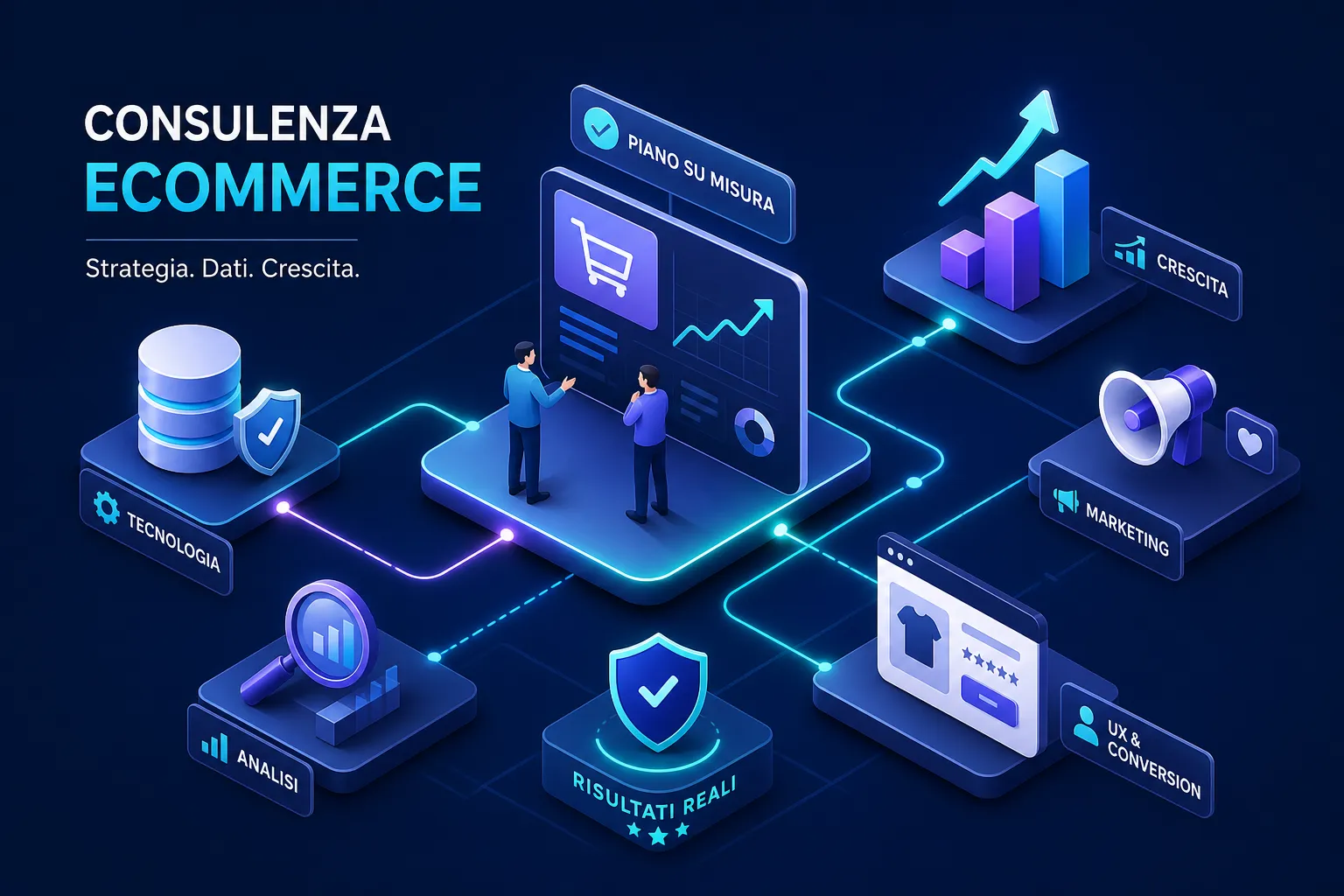
Many Italian SMEs invest in eCommerce consulting without the criteria to assess it. The result? A tidy presentation, a few generic recommendations and nothing measurable after the first months. The problem is not the wrong consultant: it is not knowing what to ask before signing.
Serious consulting is not a sales chat. It is a structured process that starts from an in-depth diagnosis of the online store, defines a concrete roadmap with deadlines and KPIs, and is measured on the numbers. At Zeno Web every project always starts with the eCommerce audit, never with the sale: it is the only way to build a strategy that really works.
In this article you will find six concrete elements for assessing any proposal: what the initial audit must include, which services make the difference, the KPIs to put in the contract, how to read case studies without being misled, why platform specialisation matters and what an investment that pays for itself costs.
What professional eCommerce consulting really includes
The word "consulting" has become an empty container. Some use it to sell packages of standard activities, some to justify hours of meetings, some to hand over a strategy document nobody will ever read. To understand what you are really paying for, look at what happens in the first weeks.
The technical audit as a mandatory starting point
A serious consultant always starts with an in-depth technical audit: site speed, Core Web Vitals, SEO structure, DataLayer implementation, event tracking and conversion funnel analysis. Without this base, any strategy is built on assumptions. The report must show prioritised issues with an estimated impact, not a generic list of "things to improve". If you do not receive a document with specific problems and a data-based order of priority, you are not getting professional consulting.
Competitor analysis and growth roadmap
After the audit, the consultant must analyse competitive positioning: keyword gaps, competitors' pricing strategies, strengths and weaknesses of your market. This analysis is not a theoretical exercise: it must turn into an operating roadmap with deadlines, responsibilities and KPIs tied to each phase. A roadmap without data is a statement of intent, not a working tool.
The (honest) assessment of the platform
The consultant must guide you in choosing or assessing the platform based on your real needs, not on the ones they know best. PrestaShop, Shopify, WooCommerce and Magento have completely different architectures, running costs and technical requirements. This choice affects every later decision: from development to integrations, from the technical budget to future scalability.
If no analysis document with issues ranked by impact arrives in the first weeks, you are not buying consulting: you are buying hours of meetings.
The services that define complete eCommerce consulting
A complete strategic programme is not limited to strategy on paper. It must cover the whole value chain that generates revenue: from acquiring traffic to optimising the purchase process, up to integrations with company systems. Knowing which services are part of the scope lets you compare different proposals without drowning in technical detail.
SEO, CRO and campaigns: the core that generates revenue
Organic SEO, conversion rate optimisation (CRO) and advertising on Google and Meta are the operating core of any revenue-oriented consulting. Technical quick wins — fixing broken redirects, schema markup, Core Web Vitals optimisation — show up in 2-4 weeks. Strategic SEO instead takes 6-12 months to produce significant, lasting results. A consultant who does not make these timescales clear from the first meeting is selling unrealistic expectations. For more on the operating approach, see our eCommerce SEO services.
Technical integrations and smart automations
For Italian SMEs, the integrations between the eCommerce platform and management systems (ERP, CRM, warehouse) such as Zucchetti, TeamSystem or Danea are often essential to make an online store truly work without multiplying manual work — a topic we cover on the dedicated page on ERP integration with PrestaShop. Then there is the value of automation: behavioural email marketing, dynamic smart pricing, an automated customer journey. A consultant who does not address this leaves a significant part of the project uncovered. If your store is struggling, find out how to tackle an underperforming eCommerce with targeted work.
The KPIs to put in the contract (and the ones to ignore)
The consulting contract must not be just a commercial document. It must contain the indicators you will use to measure the project's success. Without contracted KPIs you have no way to tell whether the work is paying off and no leverage to ask for a change of course.
Conversion rate, AOV and customer value over time
The three core KPIs of every eCommerce project are conversion rate (CR), average order value (AOV) and Customer Lifetime Value (CLTV). CR measures how many visitors complete a purchase; AOV shows how much each customer spends per order on average; CLTV estimates the total economic value of a customer over time, taking into account purchase frequency and the length of the relationship. CLTV is the most important KPI today: it sets the maximum sustainable budget for acquiring a new customer and guides every retention strategy. The definitions of the main indicators are collected in our eCommerce glossary.
CAC, ROAS and the sustainability of growth
Customer Acquisition Cost (CAC) is calculated by dividing total marketing spend by the number of new customers acquired. The rule is simple: CAC must always be lower than CLTV. When CAC exceeds CLTV, the growth model is not sustainable, whatever the ROAS of the campaigns. ROAS optimises advertising spend, but it does not tell the full economic story: the CAC/CLTV ratio is the real compass for judging whether consulting is producing real results.
A contract without agreed KPIs cannot be measured: put CR, AOV, CLTV, CAC and how often they are reviewed in writing.
How to read case studies without being misled
Glossy case studies with rising charts and three-digit percentages are the most overused sales tool in the industry. Reading them with a critical eye protects you from promises that will not be kept.
The concrete data to ask for before you sign
Never accept a growth percentage without the starting and final absolute values. If a consultant does not show the real numbers, either they do not have them or they prefer not to show them: in both cases it is a warning sign. Always ask: I started from X orders a month, I reached Y. You can compare the approach with our eCommerce case studies, published only with verifiable sources and comparison periods.
Documented ROI and signs of window-dressing consulting
The ROI of consulting can be read directly: every euro invested must generate a measurable return. Ask for real screenshots from Google Analytics, Semrush or the eCommerce platform showing the data before and after the work. The signs of superficial consulting are always the same: vague claims with no numbers, no KPIs agreed in the contract, case studies with no sector or reference period. Asking for direct references from verifiable clients is not rude: it is due diligence.
Platform and specialisation: not every consultant can do everything
Choosing a platform is not an aesthetic preference. It determines the technical skills needed, development and maintenance costs, integration options and future scalability.
What changes between PrestaShop, Shopify, Magento and WooCommerce
Magento (Adobe Commerce) is designed for large catalogues and complex customisation, with high project costs and the need for a specialist team for every change. Shopify is the right choice for those who want simplicity without custom development. WooCommerce is ideal for those already on WordPress who want to keep a familiar ecosystem. PrestaShop offers highly customisable open source with total control over the architecture: that is why many Italian SMEs choose it when they want to grow without depending on a proprietary platform. For a practical comparison read which eCommerce platform to choose and the direct comparison PrestaShop vs Shopify.
Why the consultant's specialisation changes the result
A generalist consultant may know every platform on the surface but optimise none in depth. A certified PrestaShop Partner knows the logic of modules, hooks and overrides that a generic professional ignores: this translates into cleaner ERP integrations, better performance on large catalogues and faster debugging when something does not work. Specialisation is not a sales detail: it is a technical guarantee, measurable in development time and in the stability of the project. Talk to an experienced eCommerce agency before choosing the platform: changing course once the project has started costs far more. If you are weighing a firm against an individual professional, the comparison eCommerce agency or freelancer can help.
Costs and value: how much to invest in eCommerce consulting
The Italian market shows a very wide price range, often hard to compare because proposals include different services with similar names. Having a clear reference helps you tell when you are looking at a serious investment and when at an undersized package.
Basic package vs advanced strategic consulting
- Basic package (audit + strategy): 1,000-3,500 euro, fixed-price project.
- Advanced strategic consulting (3-12 months): 5,000-15,000 euro in total, or 900-5,000 euro a month on retainer.
- Senior hourly consulting: 100-300 euro per hour.
Avoid offers under 900 euro a month: they almost always mean superficial work, automation with no real oversight, or standard packages that ignore the specifics of your store. To get your bearings on the cost items of a full project you can read how much it costs to hire an eCommerce agency or request an eCommerce quote.
When cost becomes an investment
The right consultant generates measurable ROI from the first months of work, not just at the end of the project. At Zeno Web every strategic eCommerce consulting engagement starts with an in-depth technical audit that becomes the basis of the operating roadmap: we do not hand over generic strategies, but action plans built on your store's real data. The aim is not consulting in itself: it is the revenue that comes from it. A proven method built over years of working exclusively on eCommerce is what turns an audit into real, measurable growth.
In short: the six selection criteria
- A data-based technical audit.
- An operating roadmap with contracted KPIs.
- Services covering SEO, CRO, campaigns and integrations.
- Case studies with verifiable numbers.
- Real specialisation on the chosen platform.
- Costs proportionate to the value generated.
The difference between an engagement that works and one that does not is not the price paid: it is the methodology behind it. If you are considering consulting for your online store, start with someone who has already done that work for Italian merchants.
Related reading
- eCommerce audit: what we analyse
- Strategic eCommerce consulting
- How to choose an eCommerce agency
- Zeno Web eCommerce blog
- eCommerce resources
Last editorial check: 17 August 2026.
Want to know if consulting makes sense in your case?
Thirty minutes, no sales pitch: you tell us the situation and we tell you how we read it.
No commitment: if now is not the right time, we will tell you.